SANAA Experience

Regenerative spine care · Herniated disc

Herniated discStem cells, without open surgery

A minimally invasive procedure that applies stem cells into the affected disc to support regeneration of the nucleus pulposus and reduce inflammation of the compressed nerve. The initial evaluation determines whether you are a candidate.

Lumbar and cervical herniations · Anesthetic sedation guided by imaging · No hospital stay · First consultation of 45 minutes

Quick answer

How is a herniated disc treated with stem cells?

It is a minimally invasive procedure that applies stem cells into the affected disc, with image-guided anesthetic sedation and no hospital stay, to support regeneration of the nucleus pulposus and reduce inflammation of the compressed nerve. It is indicated for hernias without severe neurological deficit; the initial evaluation decides whether you are a candidate.

Updated

Is it for me?

It is indicated for herniations without severe neurological deficit. If you have already had spine surgery, it is evaluated case by case.

If you recognize yourself in any of these

  • You have a herniated disc without severe neurological deficit.
  • You want to avoid spine surgery.
  • Your sciatic pain does not go away.
  • Your disc keeps wearing down.

It is not for you if there is

  • Cauda equina syndrome
  • Severe progressive neurological deficit
  • Structural spinal instability
  • Active spinal cancer

The initial evaluation confirms it.

What will be done?

What it is

It is a minimally invasive procedure that applies stem cells directly into the affected intervertebral disc to support regeneration of the nucleus pulposus, reduce inflammation of the compressed nerve and relieve radicular pain.

Conditions it treats

  • Lumbar herniated disc
  • Cervical herniated disc
  • Disc protrusion
  • Spinal stenosis
  • Chronic sciatic pain
  • Degenerative disc disease

How it works

  • Nucleus pulposus regenerationRestoration of the central component of the intervertebral disc.
  • Reduced nerve inflammationRelief of compression on the affected spinal nerve.
  • Annulus fibrosus self-repairStimulation of disc cells for natural repair.
  • Neuropathic pain modulationReduction of sciatica-type radicular pain.

Step by step

  1. 1

    Initial evaluation

    A consultation with Dr. Guerrero Silva. He reviews your history and tests to decide whether you are a candidate and what to aim for with treatment.

    45-minute consultation, virtual or in person

  2. 2

    Protocol design

    A plan made for you: type of stem cells, concentration, delivery route and complementary therapies such as IV therapy, laser or magnetotherapy.

    Depending on your case: IV therapy, laser or magnetotherapy

  3. 3

    Treatment

    Performed in facilities licensed by the Bogotá Health Department. The cells are processed in biosafety level II laboratories.

    Continuous medical supervision

  4. 4

    Follow-up

    Medical check-ups after treatment to verify how you respond and adjust the protocol.

    We don’t promise cures: we pursue real, sustainable, measurable results

How many sessions and what results?

Every case progresses differently: these are the usual milestones of follow-up. We do not promise cures; we aim for real, sustainable and measurable results.

Procedure
Under anesthetic sedation, guided by imaging; most patients describe it as a traditional injection. No hospital stay.
Activities
Daily ones within a few days; greater exertion between 4 and 8 weeks depending on your progress.
Sessions
The number is set by the medical evaluation.
  1. First weeks
    • Reduced low back pain
    • Less sciatic pain
  2. 1 to 3 months
    • Better posture and mobility
    • Less use of painkillers
  3. 6 months or more
    • Disc regeneration that lasts over time
    • Medical follow-up for 6 to 12 months

Who will treat me?

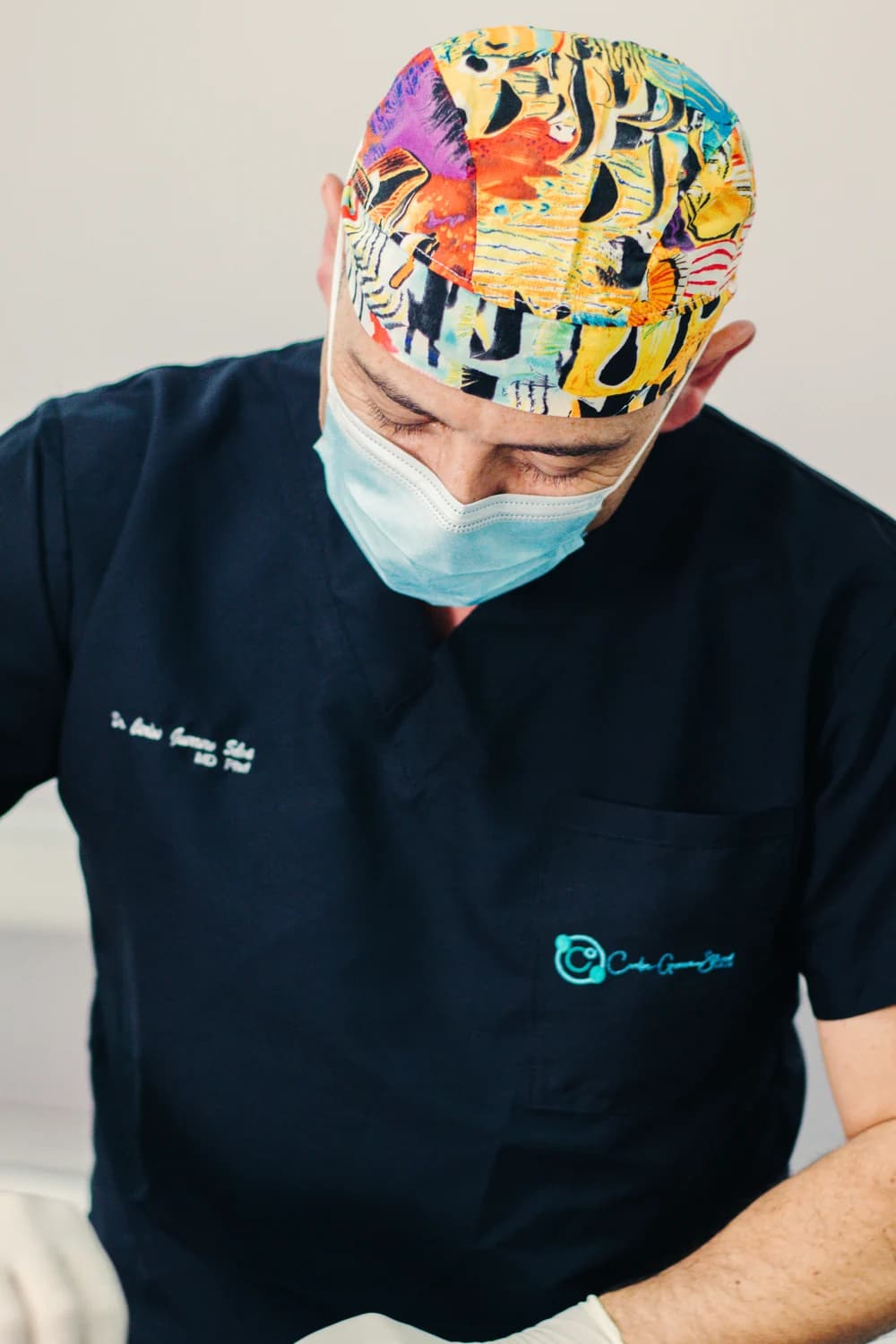
Dr. Carlos Guerrero Silva in surgical scrubs

Dr. Carlos Guerrero Silva

Orthopedic surgeon · Medical director

PhD in Regenerative Medicine and Stem Cells
Cambridge International University, 2020
Diplomate, American Board of Regenerative Medicine
Certificate No. 307, 2022
Orthopedics and Traumatology
Universidad de Buenos Aires · Hospital de Clínicas José de San Martín, 1996–2001

They are joined by Dr. Mónica Díaz (anesthesiology) and Dr. María Paula Guerrero (clinical physician). Since 2014 · more than 5,000 patients from 15 countries, aged 2 to 92.

Meet the team

Frequently asked questions

Can I avoid spine surgery with this treatment?

In most cases, yes, especially for herniations without severe neurological deficit. The initial evaluation determines if you’re a candidate.

Does it work for cervical and lumbar hernias?

Yes, both locations respond well to regenerative treatment.

Is the application procedure painful?

It’s performed under anesthetic sedation guided by imaging. Most patients describe it as a traditional injection.

When can I resume my normal activities?

Daily activities within a few days. Greater exertion between 4-8 weeks depending on clinical progress.

What if I’ve already had spine surgery?

It’s evaluated case by case. Regenerative medicine can be a valid option for patients with persistent post-surgical pain.

Can stem cell therapy help with disc degeneration, not just an acute herniation?

Yes. Degenerative disc disease is one of the conditions we treat — stem cells stimulate regeneration of the nucleus pulposus and the annulus fibrosus, the same structures affected by age-related disc degeneration, not only acute herniations.

Your first consultationlasts 45 minutes

It is with Dr. Guerrero Silva, virtual or in person. He reviews your history and your tests to decide whether you are a candidate and what to aim for with the treatment.

Clinic
Calle 119 #13-45, 5th floor, Bogotá
Hours
Monday to Friday, 8:30 a.m. – 5:00 p.m.