Regenerative orthopedics · Knee osteoarthritis
Treating knee osteoarthritisStem cells, without surgery
We apply stem cells into the joint, guided by ultrasound, to modulate inflammation and stimulate repair of the knee cartilage. The initial evaluation, with an MRI, defines the prognosis.
Grade I, II and III gonarthrosis · Evaluated with an MRI · Local anesthesia guided by ultrasound · First consultation of 45 minutes
Quick answer
How is knee osteoarthritis treated with stem cells?
Stem cells are applied into the knee joint, guided by ultrasound and under local anesthesia, to modulate inflammation and stimulate cartilage repair. Grades I, II and III respond well; in grade IV the evaluation decides whether enough cartilage remains. An MRI beforehand defines the prognosis.
Updated
Is it for me?
Grades I, II and III respond well. In grade IV, with total destruction, the evaluation decides whether enough cartilage remains to stimulate regeneration.
If you recognize yourself in any of these
- You have grade I, II or III gonarthrosis.
- You are an athlete with chronic joint wear.
- You are an active person and want to avoid a knee replacement.
- Traditional injections have not worked for you.
- Your knee has hurt for more than 3 months.
It is not for you if there is
- End-stage grade IV knee osteoarthritis with total destruction
- Active joint infection
- Active cancer
- Uncontrolled coagulopathies
The initial evaluation confirms it.
What will be done?
What it is
Gonarthrosis —knee osteoarthritis— is the progressive degeneration of the joint cartilage. The protocol applies stem cells into the knee to stimulate cartilage repair, modulate intra-articular inflammation and restore lubrication.
Conditions it treats
- Grade I, II, and III knee osteoarthritis
- Joint wear in athletes
- Chronic knee pain
- Patellar chondromalacia
- Knee arthritis
- Post-arthroscopy sequelae
How it works
- Differentiation into chondrocytesStem cells transform into cartilage cells that rebuild knee joint tissue.
- Local growth factorsRelease of molecules that activate repair and halt cartilage breakdown.
- Anti-inflammatory modulationReduces chronic intra-articular inflammation that perpetuates pain and deterioration.
- Synovial fluid restorationRestores joint lubrication for smooth, friction-free movement.
Step by step
- 1
Initial evaluation
A consultation with Dr. Guerrero Silva. He reviews your history and tests to decide whether you are a candidate and what to aim for with treatment.
45-minute consultation, virtual or in person
- 2
Protocol design
A plan made for you: type of stem cells, concentration, delivery route and complementary therapies such as IV therapy, laser or magnetotherapy.
Depending on your case: IV therapy, laser or magnetotherapy
- 3
Treatment
Performed in facilities licensed by the Bogotá Health Department. The cells are processed in biosafety level II laboratories.
Continuous medical supervision
- 4
Follow-up
Medical check-ups after treatment to verify how you respond and adjust the protocol.
We don’t promise cures: we pursue real, sustainable, measurable results
How many sessions and what results?
Every case progresses differently: these are the usual milestones of follow-up. We do not promise cures; we aim for real, sustainable and measurable results.
- Procedure
- With local anesthesia, guided by ultrasound; most patients describe it as a conventional injection. No hospital stay.
- Both knees
- If your clinical condition allows it, both are treated in the same session.
- Sessions
- The number is set by the medical evaluation.
- First weeks
- Pain reduction, from 2 to 3 weeks
- Less knee inflammation
- 1 to 3 months
- Better range of flexion and extension
- Less need for painkillers
- 6 months or more
- Cartilage regeneration, verified by imaging, between 3 and 6 months
- Gradual return to sport or daily activity
A real testimonial
Watch their story on video«I avoided a knee replacement thanks to the stem cell treatment.»
Who will treat me?

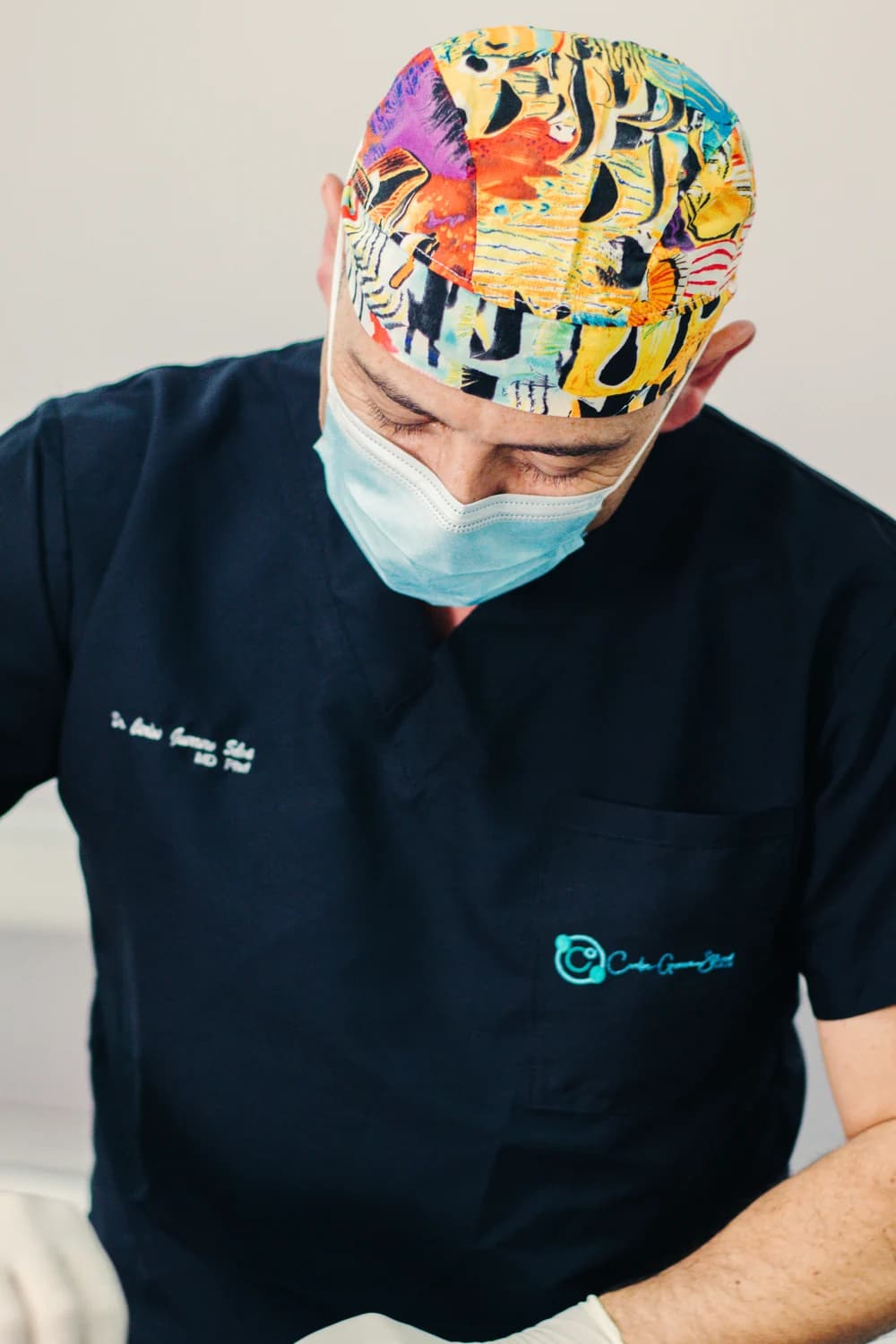
Dr. Carlos Guerrero Silva
Orthopedic surgeon · Medical director
- PhD in Regenerative Medicine and Stem Cells
- Cambridge International University, 2020
- Diplomate, American Board of Regenerative Medicine
- Certificate No. 307, 2022
- Orthopedics and Traumatology
- Universidad de Buenos Aires · Hospital de Clínicas José de San Martín, 1996–2001
They are joined by Dr. Mónica Díaz (anesthesiology) and Dr. María Paula Guerrero (clinical physician). Since 2014 · more than 5,000 patients from 15 countries, aged 2 to 92.
Meet the teamFrequently asked questions
What grade of knee osteoarthritis does the treatment work for?+–
Grades I, II, and III respond very well. In grade IV with total destruction, we assess whether enough cartilage remains to stimulate regeneration. The initial MRI evaluation defines the prognosis.
When do I start feeling improvement?+–
Pain reduction begins between 2 and 3 weeks. Structural cartilage regeneration, verified by imaging, is observed between 3 and 6 months post-treatment.
Can I avoid total knee replacement?+–
In the vast majority of grade I-III cases, yes. The SANAA protocol is specifically designed to avoid both repeated arthroscopies and replacement arthroplasty.
Is the procedure painful?+–
No. It’s performed under local anesthesia guided by ultrasound. Most patients describe it as a conventional injection. No hospitalization, no prolonged downtime.
Can I go back to playing sports?+–
Yes. It’s one of the main goals of treatment for athletic patients. Progressive return to activity is planned from the start of the protocol based on the sport.
Does it work on both knees at the same time?+–
Yes. We can treat both joints in the same session if the clinical condition allows, reducing time and number of interventions.
Your first consultationlasts 45 minutes
It is with Dr. Guerrero Silva, virtual or in person. He reviews your history and your tests to decide whether you are a candidate and what to aim for with the treatment.
- Clinic
- Calle 119 #13-45, 5th floor, Bogotá
- Hours
- Monday to Friday, 8:30 a.m. – 5:00 p.m.
- Phone
- +57 350 783 6166