
Quick answer
What is hyperbaric oxygen therapy and how does it work?
Hyperbaric oxygen therapy is a treatment in which a person breathes nearly pure oxygen inside a pressurized chamber, so more oxygen dissolves in the blood and reaches tissues12. It is used for a specific list of wounds, injuries and infections, and researchers continue to study other possible uses12.
How does a hyperbaric oxygen session work?
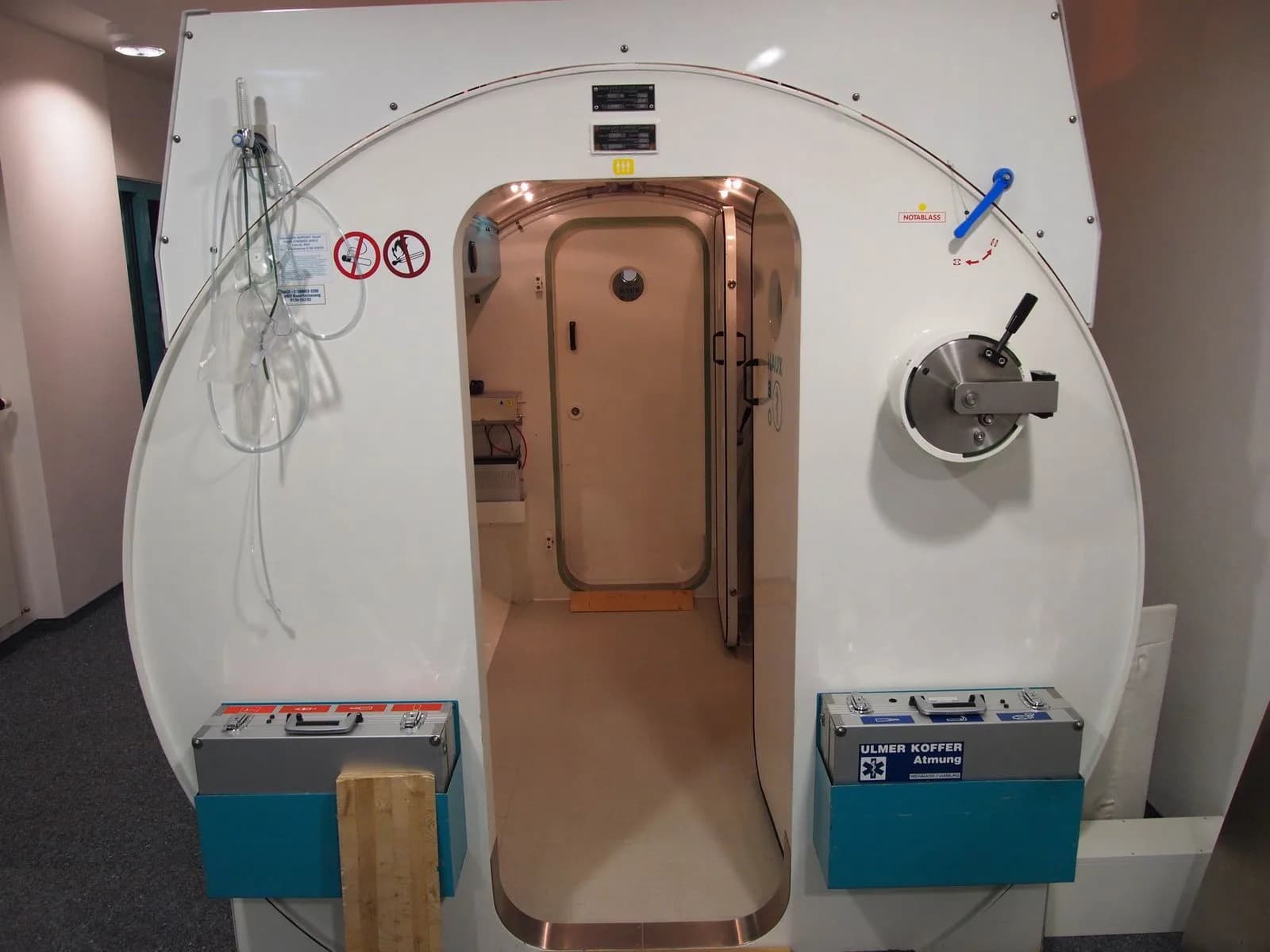
A session takes place inside a hyperbaric chamber, where the pressure around the body rises while the person breathes oxygen, so more of it dissolves in plasma and reaches tissues14. In everyday breathing, most oxygen travels attached to hemoglobin inside red blood cells, with a small share dissolved in plasma1. Raising the surrounding pressure increases oxygen levels in the blood and in tissue, and a 2021 overview connected this with applications in poorly oxygenated regions1. MedlinePlus describes the same principle for the general reader: the extra oxygen moves through the blood to organs and body tissues2.
Current society-approved indications call for near-pure oxygen at a pressure of at least 2 ATA1. Treatment is given in a hard chamber, and nearly all uses cleared by the FDA are delivered between 2.0 and 3.0 ATA4. Protocols vary: an estimated 1.5 to 2 hours per session, one to three sessions a day, and a course of 20 to 60 treatments depending on the condition1. Some studies have reported promising results at lower pressures, around 1.5 atmospheres, for certain conditions1.
Chambers come in two designs, and the difference shapes how oxygen reaches the person inside1.
Multiplace chambers are described as allowing closer monitoring of vital functions in critically ill patients, while single-person chambers are also reported as safe1.
What is the difference between HBOT and mild hyperbaric oxygen therapy?
Conventional hyperbaric oxygen therapy gives pure oxygen in a hard chamber at pressures above normal atmosphere, whereas mild hyperbaric therapy is usually given in a low-pressure, soft-sided chamber that uses room air or oxygen from a concentrator4. A narrative review by Morningstar and Strauchman in Medical Sciences argued that the two should not be treated as synonyms, because pressure, oxygen content and the resulting physiological responses may differ substantially4.
That review reported that the evidence for hyperbaric oxygen comes mainly from controlled studies run at higher pressures, while support for mild hyperbaric therapy is very limited, of poor methodological quality and often borrowed from those higher-pressure studies4. The authors stated that their aim was not to suggest that lower-pressure exposures are biologically inactive4. They also called for clearer classification criteria covering pressure, oxygen and chamber type4.
The practical distinctions come down to the chamber, the gas and the pressure used4.
| Feature | HBOT | Mild hyperbaric therapy | Source |
|---|---|---|---|
| Chamber | Hard chamber | Low-pressure soft chamber | 4 |
| Gas breathed | Pure oxygen | Room air or oxygen from a concentrator | 4 |
| Pressure | 2.0 to 3.0 ATA for nearly all cleared uses | Low pressure | 4 |
| Evidence base | Extensive controlled clinical studies | Very limited and of poor methodological quality | 4 |
What does research show about hyperbaric oxygen therapy?
Research on hyperbaric oxygen has produced its clearest results in a small number of specific conditions, where reviews describe it as an adjunct to standard care rather than a replacement for it13. A systematic review and meta-analysis by Sharma and colleagues in Scientific Reports pooled 14 controlled studies, including 12 randomized trials, with 768 participants who had diabetic foot ulcers3. The pooled analysis found that hyperbaric oxygen was significantly associated with complete healing and with fewer major amputations, while minor amputations and the mean percentage reduction of ulcer area did not differ between groups3. The authors cautioned that the results should be extended to wider practice with care, given methodological flaws in the included studies3.
0.29odds ratio
pooled result for complete healing of diabetic foot ulcers with hyperbaric oxygen
Source: 3
Mechanistic work summarized in one review suggests several pathways: new vessel growth through redox-sensitive signaling that involves hypoxia-inducible factor-1α and vascular endothelial growth factor, faster fibroblast activity, more progenitor cells carrying CD34, and antioxidant and anti-inflammatory effects that moderate ischemia-reperfusion injury5. A 2021 overview published in Medicina described antimicrobial, immunomodulatory and angiogenic properties1.
Which conditions is hyperbaric oxygen therapy used for?
Hyperbaric oxygen therapy has a defined list of approved indications and is not a general treatment for any condition142. A 2021 review counted 14 approved indications and noted that a European consensus conference described the therapy as a primary approach for some conditions, such as carbon monoxide poisoning, and as a possible adjunct in others, such as diabetic foot1.
- Air or gas embolism, and decompression sickness in divers2
- Carbon monoxide poisoning, described at a European consensus conference as a primary indication1
- Certain serious wounds, burns, injuries and infections2
- Radiation injury, necrotizing infections and ischemic wounds, treated at 2.0 to 3.0 atmospheres4
- Severe anemia and idiopathic sensorial hearing loss1
A public reference page from MedlinePlus lists serious wounds, burns, injuries and infections among the treated conditions, along with air or gas embolisms and carbon monoxide poisoning2. The same page notes that the Food and Drug Administration has not cleared or approved hyperbaric oxygen therapy for conditions such as Alzheimer's disease, autism, cancer or Lyme disease, and advises people to speak with a health care provider before trying it2.
What is still being studied?
Research continues on whether hyperbaric oxygen may help in conditions beyond its approved list, and reviews describe that work as promising but not settled15. The 2021 overview named inflammatory and systemic diseases, COVID-19 and cancer as potential areas of research, and encouraged further clinical study of the therapy1. A review in Medical Gas Research reported associations with better take of grafts, better salvage of flaps and better muscle recovery in trauma, reconstructive and orthopedic settings, and with promise in preconditioning for cardiac surgery5. The same review observed that wider adoption is limited by cost, coverage restrictions and differences between protocols, and called for standardized protocols and multicenter randomized trials5.
Frequently asked questions
How long does a hyperbaric oxygen session last?
Sessions typically last an estimated 1.5 to 2 hours, depending on the protocol1. They may be given one to three times a day, and a course can run from 20 to 60 treatments depending on the condition being treated1.
Is hyperbaric oxygen therapy the same as home oxygen therapy?
No: standard oxygen therapy delivers extra oxygen through a nose tube, mask or tent at everyday air pressure2. Hyperbaric oxygen therapy instead takes place in a pressurized chamber or tube, where the lungs can take in as much as three times the oxygen available at normal pressure2.
Does hyperbaric oxygen therapy replace standard treatment?
No: in the diabetic foot ulcer evidence it was assessed as an adjunct to standard treatment rather than a replacement3. A European consensus conference described it as a primary approach for some conditions, such as carbon monoxide poisoning1.
Can hyperbaric oxygen therapy treat any condition?
No: it is approved for a defined list that includes decompression sickness, carbon monoxide poisoning and certain wounds, burns and infections12. The FDA has not cleared or approved it for conditions such as Alzheimer's disease, autism, cancer or Lyme disease2.